Screen, aspect and shaders
Change how the game sits on the top screen and how it looks, from widescreen EXPAND to LCD and CRT filters, frames, themes and dark mode.
The top screen is wider than a GBA, so there's a choice to make about the space around the game. You can keep the GBA's own shape, stretch it, or let PokeDaisy draw more of the world into the gaps. On top of that you can run the picture through a filter, put a frame around it and give the app's windows a theme or a dark look.
Everything on this page is in the SCREEN group of Settings, on both screens: the top screen's Settings (from the library) and the companion's SETTINGS tab. STATUS BAR, SHADERS, OVERLAY and LIGHT COMPANION are on its DISPLAY OPTIONS page. A change made on the companion shows on the game straight away.
Aspect: how the game fills the screen
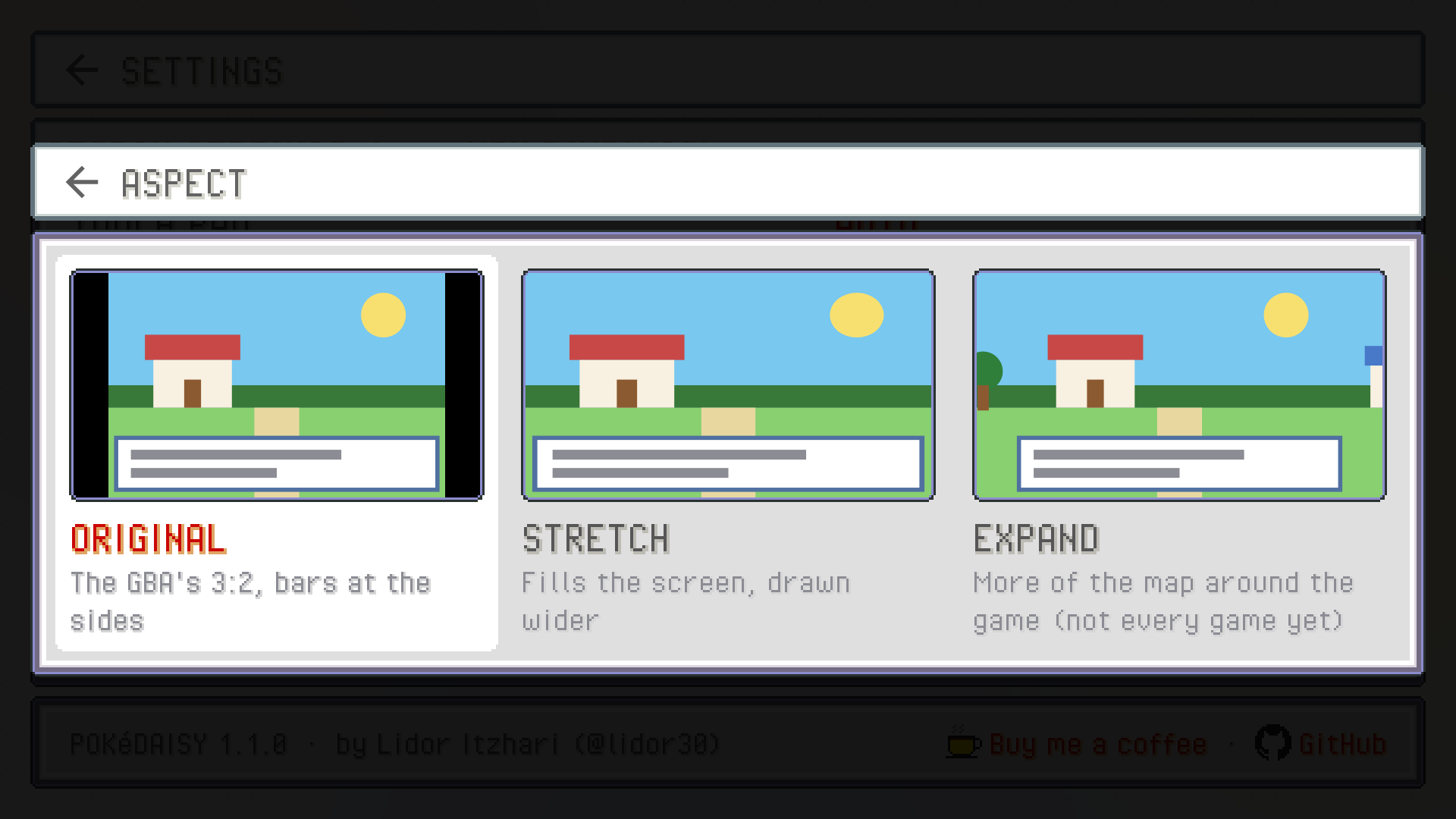
ASPECT has three choices:
| Choice | What you get |
|---|---|
ORIGINAL | The GBA's 3:2 picture, as big as it fits, with bars at the sides. This is the default. |
STRETCH | The game stretched sideways to fill the screen. No bars, but everything looks a bit wider than it should. |
EXPAND | The map drawn past the GBA's edges, so the whole screen is game with square pixels and nothing stretched. Only in the games that support it. |
On the top screen, ASPECT opens a preview: each choice is drawn as a little top screen, using your newest save state picture when there is one. Tap the one you want. On the companion it's a pick-list, and the game changes as soon as you pick.
EXPAND: more of the map
With EXPAND you see more of the route around you instead of black bars. The strips beside the game aren't stretched or made up: they're rebuilt every frame from the game's own map, tiles and characters, so people walk in from the edges, water moves and the lighting matches. On a phone held upright the extra map goes above and below the game instead.
A few things worth knowing:
Battles are wide too. The battle scenery carries on past the edges, and Pokémon, trainers and health boxes slide in from off screen. Some hacks only draw their battle scenes as wide as the screen; there the scene is mirrored out from its edges so it still flows on. The dark band behind the text and the battle menu runs right across.
Weather and caves work. Fog, ash and rain reach the screen's edges, and a dark cave stays dark around your light.
Menus and the title screen can't be extended, so there the strips glow softly with the colours at the game's edges, and fade back into the map when you return to it.
Supported games: FireRed, LeafGreen, Emerald, Ruby and Sapphire (every language and revision), plus Unbound, Radical Red, Lazarus, SoulGold, Heart and Soul, Gaia, Odyssey, Amethyst 1.3.0, Glazed, Seaglass, Emerald Imperium, Emerald Legacy, Emerald Rogue, Too Many Types 2, Recharged Yellow, Super Mariomon, Ultra Violet, FireRed Rocket Edition, Ash Gray, Let's Go, Elite Redux, Monomyth, Epsilon Emerald, Sword and Shield Ultimate Plus, GS Chronicles and Celia's hack.
DS games: Platinum, HeartGold, SoulSilver, Black, White, Black 2, White 2, Origin HeartGold and Heartfelt Gold. Their 3D world goes on past the screen, and so do their battles: the whole battle scene of Black, White and their sequels, sky, ground and all, and the others' battle backgrounds with the health boxes carried to the edges.
On the Game Boy: Yellow (the English cart), Yellow Legacy, Crystal, Crystal Legacy, Crystal Clear and Polished Crystal (version 3.2.3, the normal build) have it too. The town or route goes on past the small screen, with the people standing in it, and zoom and looking around work the same way. People in the next town or route show up in the strips before you cross over. Text boxes, the start menu, the save prompt and the options screen keep the map around them. Battles and the other menu screens aren't widened: the strips there are plain, in the colours along the screen's sides (white in most of them, Yellow's trainer card too; black beside a screen whose top part is black).
EXPAND is tagged BETA in Settings: it works in every game listed above, but it isn't perfect yet, and now and then you may spot something at the edges that the game itself doesn't show. If you do, tell us where it happened.
In a game that doesn't support it yet, EXPAND shows as ORIGINAL and the companion's pick-list tags it NOT YET. You can leave it on: it kicks in for every game that has it.
Zoom and looking around
With EXPAND on, the ZOOM hotkey steps the view out so you see further around you. It's R3 (clicking the right stick) by default, or C on a keyboard; you can move it to any button under HOTKEYS (see Controls). No right stick? Pick the zoom from a list in the companion's Settings: ZOOM, in the SCREEN group, while a game is running. Battles, conversations and menus ease back in by themselves, so text is never tiny. Each game keeps the zoom you picked: open it again and, once you're back on the field, the view eases out to it. If you'd rather keep your zoom through conversations and signs, turn AUTO ZOOM IN off in Settings; battles and the game's menu screens, like the party, the bag or the Pokédex, still ease in.
The right stick looks around (turn off LOOK AROUND in the SCREEN group if you'd rather it didn't). Push it and the view moves; let go and it stays put until you walk, then glides back to you. Hold it while you walk and the camera looks ahead in that direction, keeping your character on screen.
DS core: DS games on weaker devices
PokeDaisy has two DS emulators. melonDS has every DS feature. DSperate needs far less from your device, so it keeps DS games at full speed on budget handhelds, older phones and tablets, and devices running 32-bit Android, where melonDS can be slow. DS CORE picks which one runs your DS games.
| Choice | What you get |
|---|---|
AUTO | DSperate on a device that looks weak or runs 32-bit Android, melonDS everywhere else. The row shows which one it picked. This is the default. |
MELONDS | Always melonDS. |
DSPERATE | Always DSperate. |
A few things worth knowing:
Some features are melonDS only for now. On DSperate,
EXPAND,DS RESOLUTIONandDS CPU BOOSTare greyed out, the companion'sPCandFLYdon't show for DS games, and fast-forward plays the music sped up (FF MUSIC'sSTEADYneeds melonDS). The companion's tabs, the touch screen,DS LAYOUT,BATTLE BUTTONS, cheats, achievements and your saves all work the same.It applies when a DS game starts. Change it in the companion while a game is running and it takes effect at
RESTART GAMEor the next time you open the game.Save in the game before you switch. Each emulator only reads its own save states. When you switch, the game starts from your save file, and the place you left it on the other emulator is kept: switch back and the game picks up there again, as long as you haven't saved in the game since. Save states you made in
STATESload only on the emulator that made them.
DS resolution: sharper 3D
The DS games (Platinum, HeartGold and SoulSilver) draw their world in 3D, and the DS drew it small: 256 by 192 pixels, so on a big screen the edges look jagged. DS RESOLUTION draws that 3D at more pixels instead.
| Choice | What you get |
|---|---|
ORIGINAL | The DS's own picture, pixel for pixel. This is the default. |
2x to 8x | The 3D drawn that many times sharper by your device's graphics chip. 4x is about as sharp as a 1080p screen can show; 6x and 8x go past it, which smooths the edges even more. |
Text, menus and anything the game draws flat keep their own pixels, so they look the same at every choice.
With 2x or more and ASPECT on EXPAND, the world past the screen's edges is drawn together with the screen in one go, just as sharp, and the strips stay smooth as you walk. Zoomed far out, the 3D is drawn a little less sharp to keep things quick; it's small on screen then anyway.
A few things worth knowing:
It works the graphics chip harder. If a game slows down or your device runs warm, pick a lower choice.
Not every device can do it. It needs a fairly recent graphics chip (OpenGL ES 3.2, which most handhelds of the last few years have). On a device without one the row shows
N/Aand the game usesORIGINAL.Some shaders step aside.
SMOOTHINGandUNLIT SCREENwork on the DS's own pixels, so they're off at2xand up.FILTERandGBA COLORSstill apply.On the companion, the row only shows while a DS game is running, and a change shows on the game straight away.
DS CPU boost: fewer slowdowns
The DS games sometimes can't finish a frame in time and hold the last picture a little longer: walking in HeartGold and SoulSilver stutters every few steps, more so with a Pokémon following you. That happens on a real DS too. DS CPU BOOST runs the DS's processor twice as fast, so the game finishes its frames and walking stays smooth. The game itself doesn't speed up: it still waits for each frame as it always does.
The overworld in these games runs at 30 frames a second on a DS as well, so that's as smooth as walking gets; the boost removes the hiccups on top of it.
It costs your device more work, so it starts on only where the device has the speed for it. On a handheld with a slower processor (no core faster than 2.3 GHz, or less than 3 GB of memory) it starts off, because there the boost takes more time than it saves. Whatever it started as, you can switch it: if a DS game runs slower with it on, or your device runs warm, turn it off. On the companion, the row only shows while a DS game is running.
When your device can't keep up
On a device that can't run a DS game at full speed, PokeDaisy keeps the game at the DS's own speed by drawing fewer pictures: it draws one frame and skips drawing the next one (or up to three) while the game itself keeps running. The music, walking and battles stay at their real pace, and the picture is a little less smooth. It happens by itself, only when it's needed, and stops when the game is light enough again. On a device so slow that skipping wouldn't bring the speed back, every frame is drawn and the game simply runs slower. Fast-forward does its own skipping, so none of this applies while it's on.
Status bar
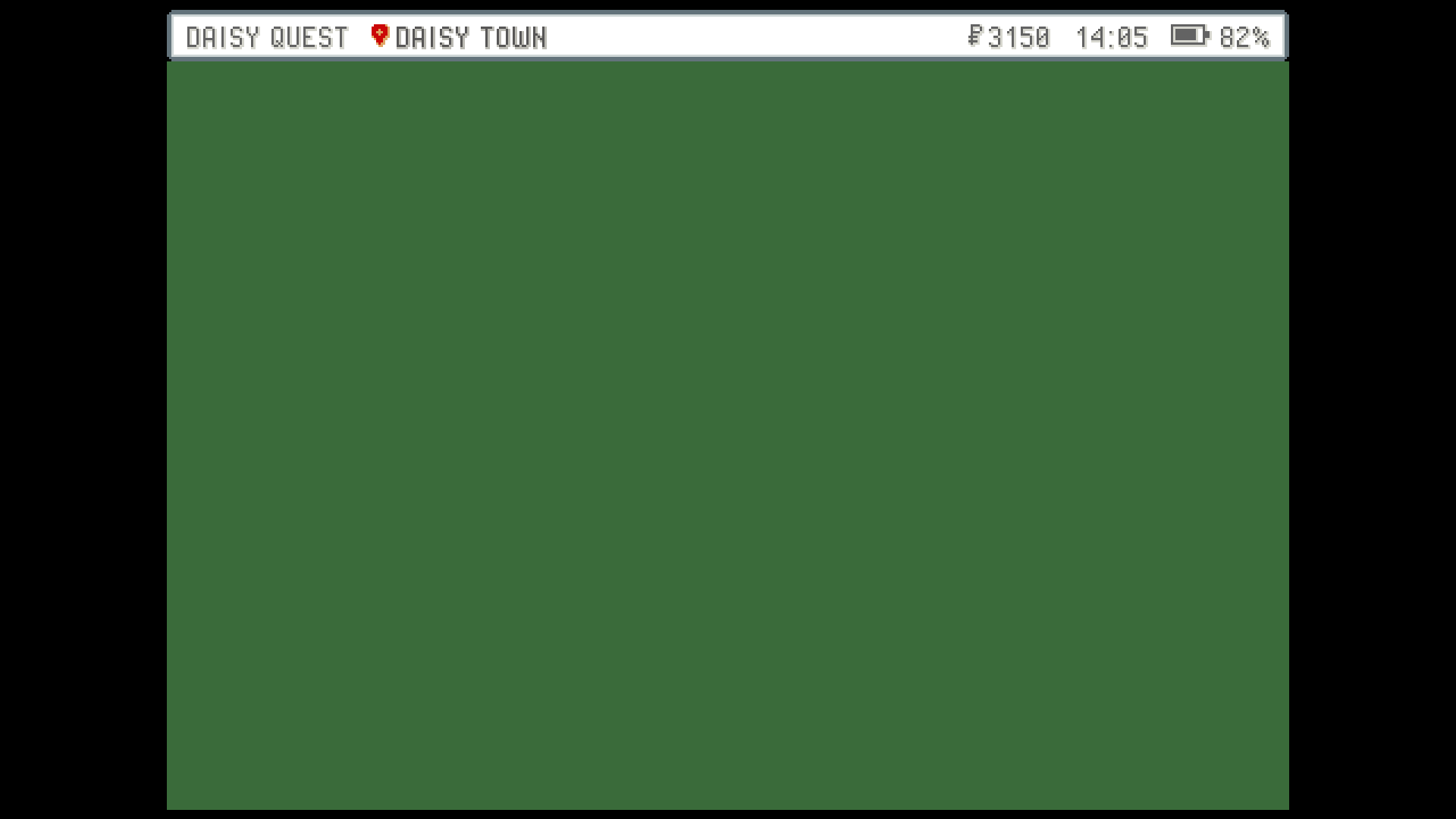
STATUS BAR adds a thin strip with the game's name, where you are, your money, the time and the battery. It's handy when the game is full screen and you can't see the device's own clock.
| Choice | Where it goes |
|---|---|
OFF | No bar (the default). |
GAME | Across the top of the game, exactly as wide as it. The game shrinks a little to make room. |
COMPANION | Over the companion's tabs on the bottom screen, so the game keeps its full size. |
The clock follows your device's 12 or 24 hour setting. Money shows for the games where PokeDaisy can read it.
Shaders
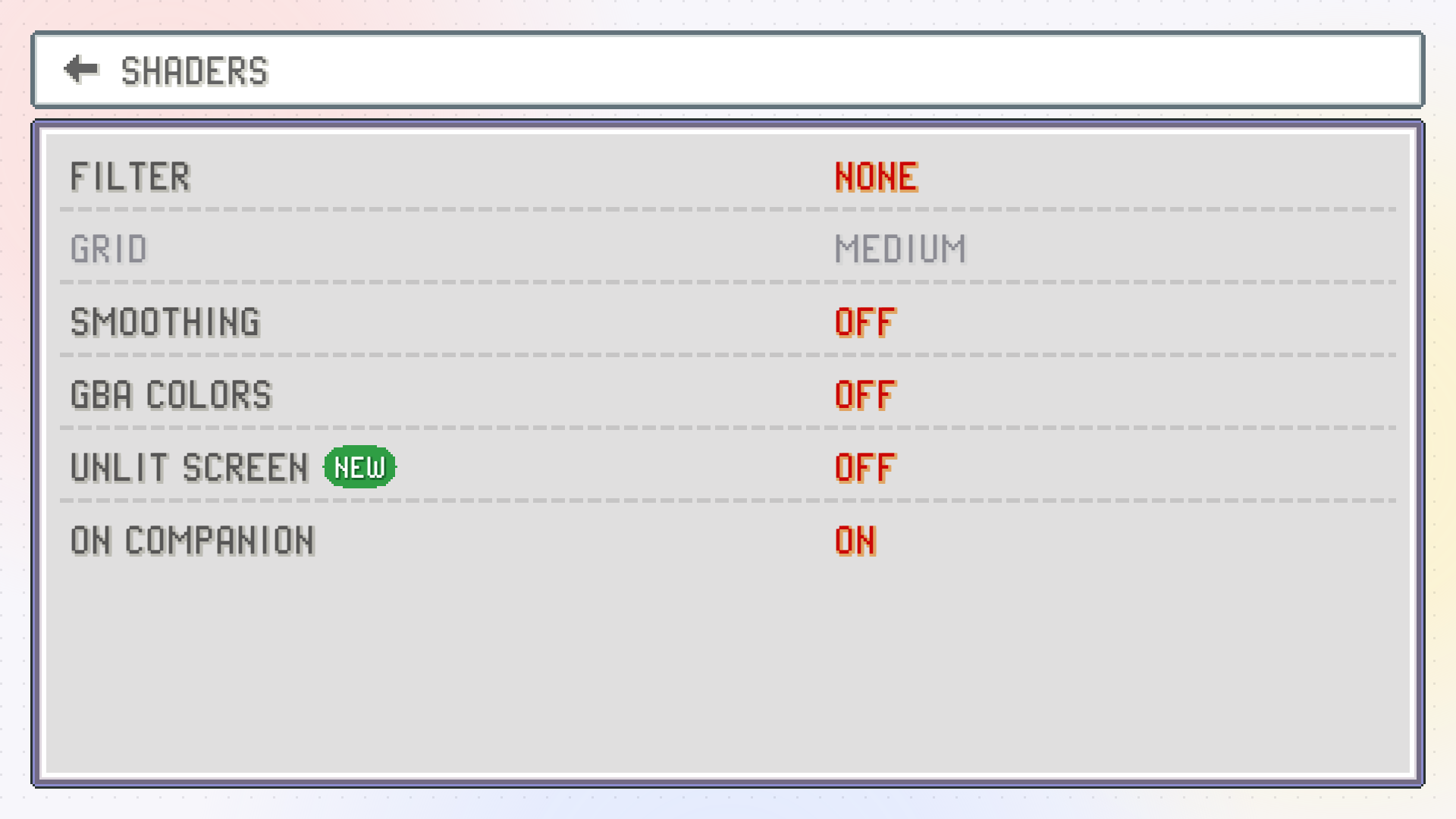
SHADERS opens a page of effects for how the game is drawn. They stack: you can have smoothing, the GBA's colours, the unlit screen and a filter all at once.
Filter
FILTER changes on every tap, so you can tap through them and watch the game change (from the companion it's instant; from the top screen the game picks it up when you go back to it).
| Filter | Look |
|---|---|
NONE | Clean pixels (the default). |
LCD | The GBA's fine pixel grid. |
LCD PAPER | A softer grid over a faint paper texture, like an unlit handheld screen. |
SCANLINES | Dark lines between the rows, like an old TV. |
CRT | Soft glowing beams and a colour mask, like a tube TV up close. |
GRID sets how strong the grid is for LCD and LCD PAPER: SOFT, MEDIUM (the default) or STRONG. It's greyed out for the other filters.
Smoothing
SMOOTHING rounds off the blocky edges of the pixel art before any filter is drawn. It's for people who like a cleaner, painted look over sharp pixels. Tap to step through:
OFF: the original pixels (the default).xBRZ: sharp, the cleanest edges.xBR: rounder and softer.SCALEFX: the most even outlines.
Smoothing only applies to the game, never to the companion. On devices whose graphics chip can't run it, the row shows N/A.
GBA COLORS
The GBA's own screen was darker and less saturated than a modern one, and the games' colours were picked for it. GBA COLORS shows them the way they looked back then. It works with any filter. Off by default.
UNLIT SCREEN
The first GBA had no light behind its screen. Light from the room went in through the screen and bounced off a dull grey green backing, so white parts of the picture showed that backing instead of glowing, and dark pixels cast a faint shadow onto it, down and to the right. UNLIT SCREEN draws the game that way. It's softer on the eyes than bright white, and it pairs well with GBA COLORS and the LCD filter. Off by default.
On the companion too
ON COMPANION (on by default) puts the same FILTER and GBA COLORS (not UNLIT SCREEN) over the companion screen and the status bar, so both screens match. The grid is sized to the game's pixels, so the lines line up with the top screen's. This needs Android 13 or newer; on older devices the companion keeps its plain look. A DS game's touch screen is part of the game, so it gets FILTER and GBA COLORS either way (Android 13 and newer).
Overlay: a frame around the game
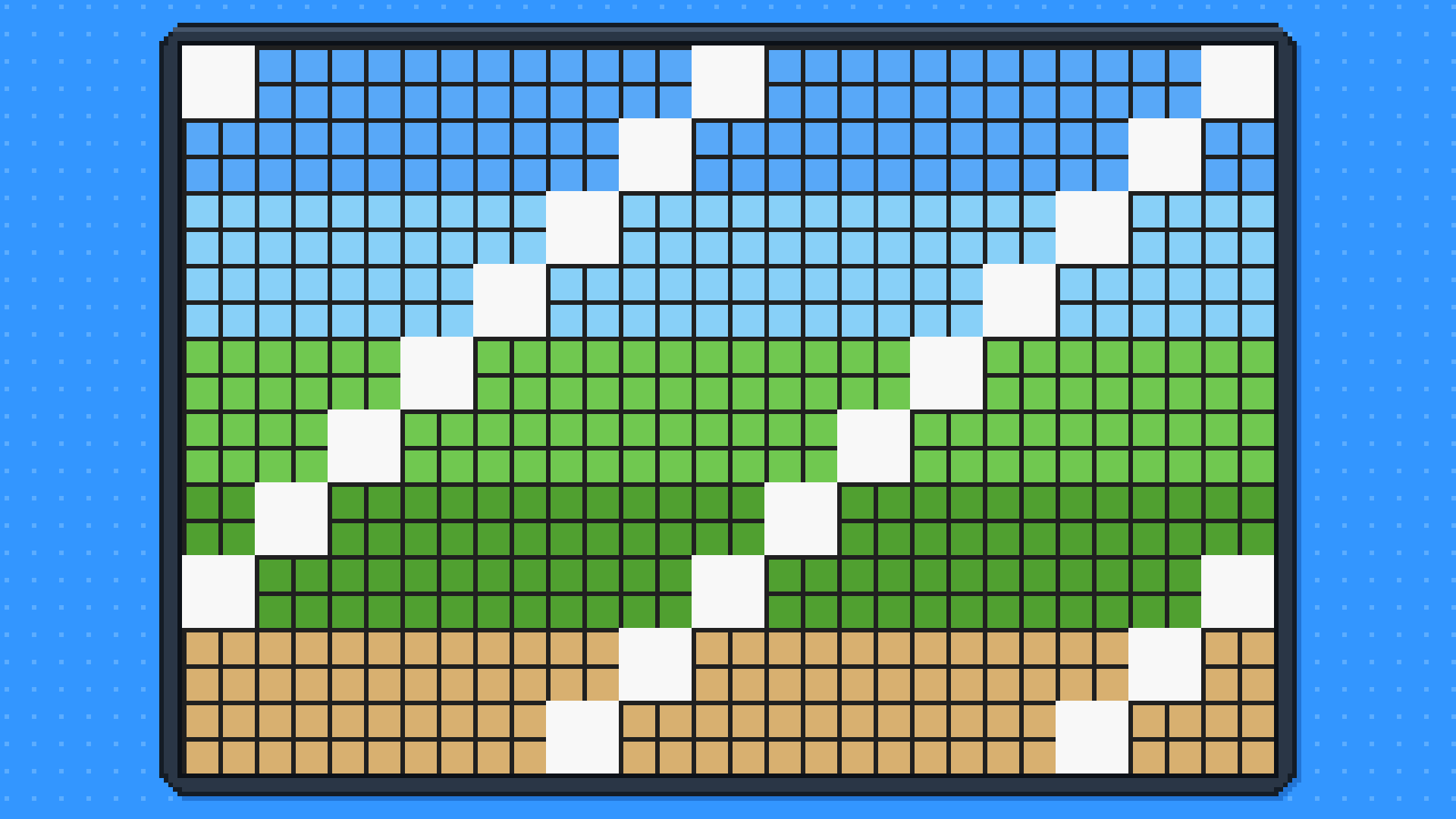
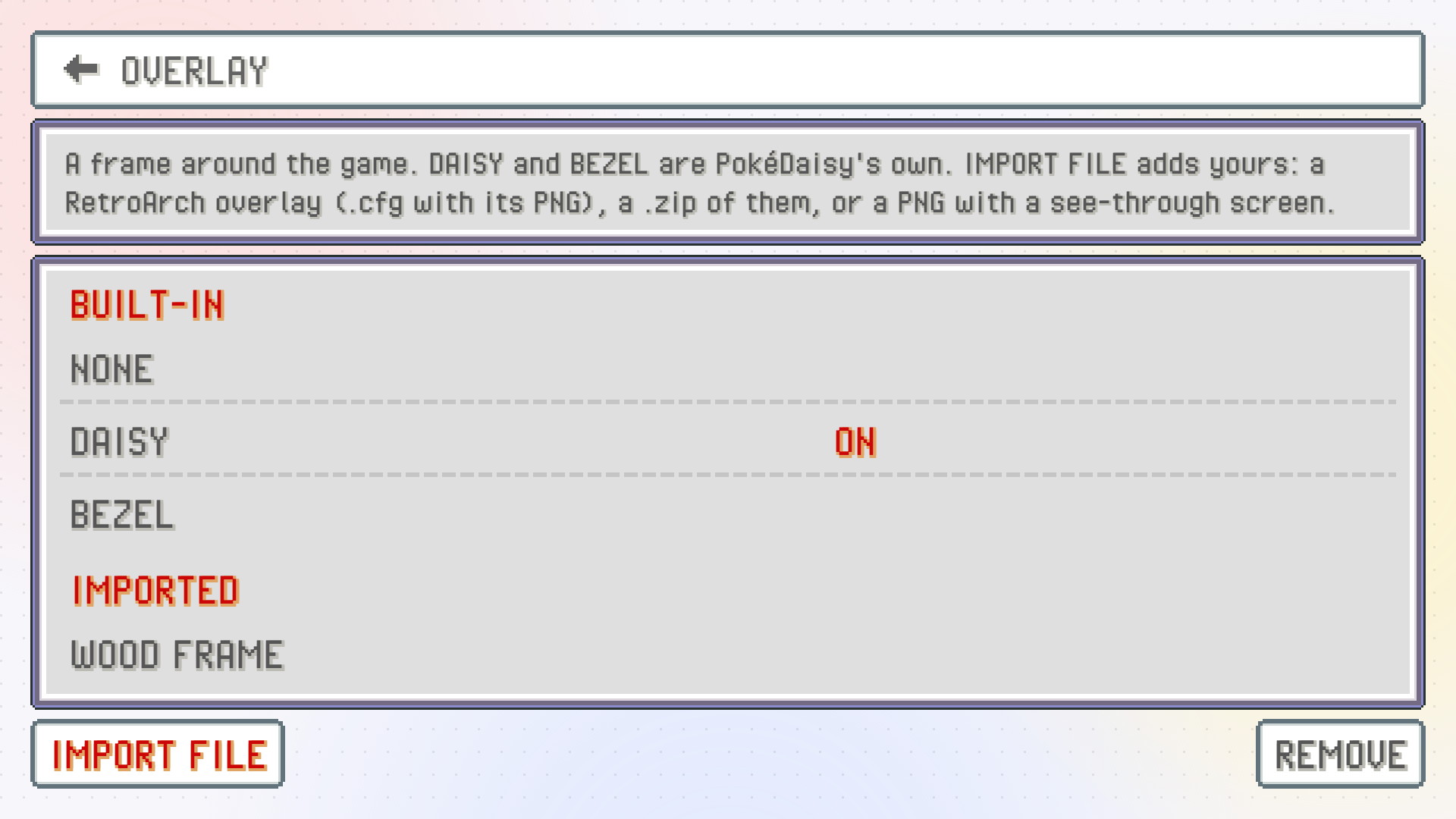
OVERLAY draws a frame around the game, filling the space a 3:2 picture leaves. PokeDaisy has two of its own:
DAISY: PokeDaisy's blue with a dot grid and the flower mark in the margin.BEZEL: a plain dark surround.
They're drawn at the game's own pixel size and the game is shown at a whole-number scale inside them, so everything stays crisp (the game is a little smaller than without a frame).
Your own RetroArch overlays
If you already use overlays in RetroArch, you can bring them over. On the top screen, open Settings > OVERLAY and tap IMPORT FILE. You can pick:
a RetroArch overlay
.cfgtogether with its PNG image,a
.zipwith overlays in it,or any PNG with a see-through hole where the screen goes.
PokeDaisy finds where the game goes from the .cfg, or from the see-through part of the PNG. A PNG with no hole is used as a background behind the game. If a .cfg arrives without its picture, it asks you to PICK THE IMAGE. A pack with both landscape and portrait versions uses whichever fits the screen.
Imported overlays are listed under IMPORTED. Tap one to use it, or use REMOVE to delete them. Once imported, you can pick them from the companion's OVERLAY list too.
Overlays are switched off on a phone held upright, where the game sits across the top. With STRETCH, the game fills the overlay's screen area.
Dark mode
DARK MODE turns the app's white and grey windows into dark slate ones with light text, on both screens at once. Nice at night or in a dim room. Each tap on the row moves to the next choice, so you see each one right away:
OFF: the light windows (the default).ON: always dark.AUTO: follows your device's dark theme setting.
The game's own art stays as it is: party slots, the map, the trainer card and battle buttons keep the game's colours. Backgrounds dim behind them.
Font
FONT sets the letters the app is written in, on both screens at once. Pick it in the top screen's Settings or in the companion's SETTINGS, under SCREEN:
PIXEL(the default): crisp pixel letters, like the games' own. A Game Boy game shows its own letters while it runs.SMOOTH: soft, rounded letters that are easy to read on any screen.SMOOTH BOLD: the same letters, heavier, closer to the games' thick menu text.SYSTEM: your device's own font.
The game's own art keeps its pixel letters: type tags, party slots and the trainer card stay as the game draws them.
Theme
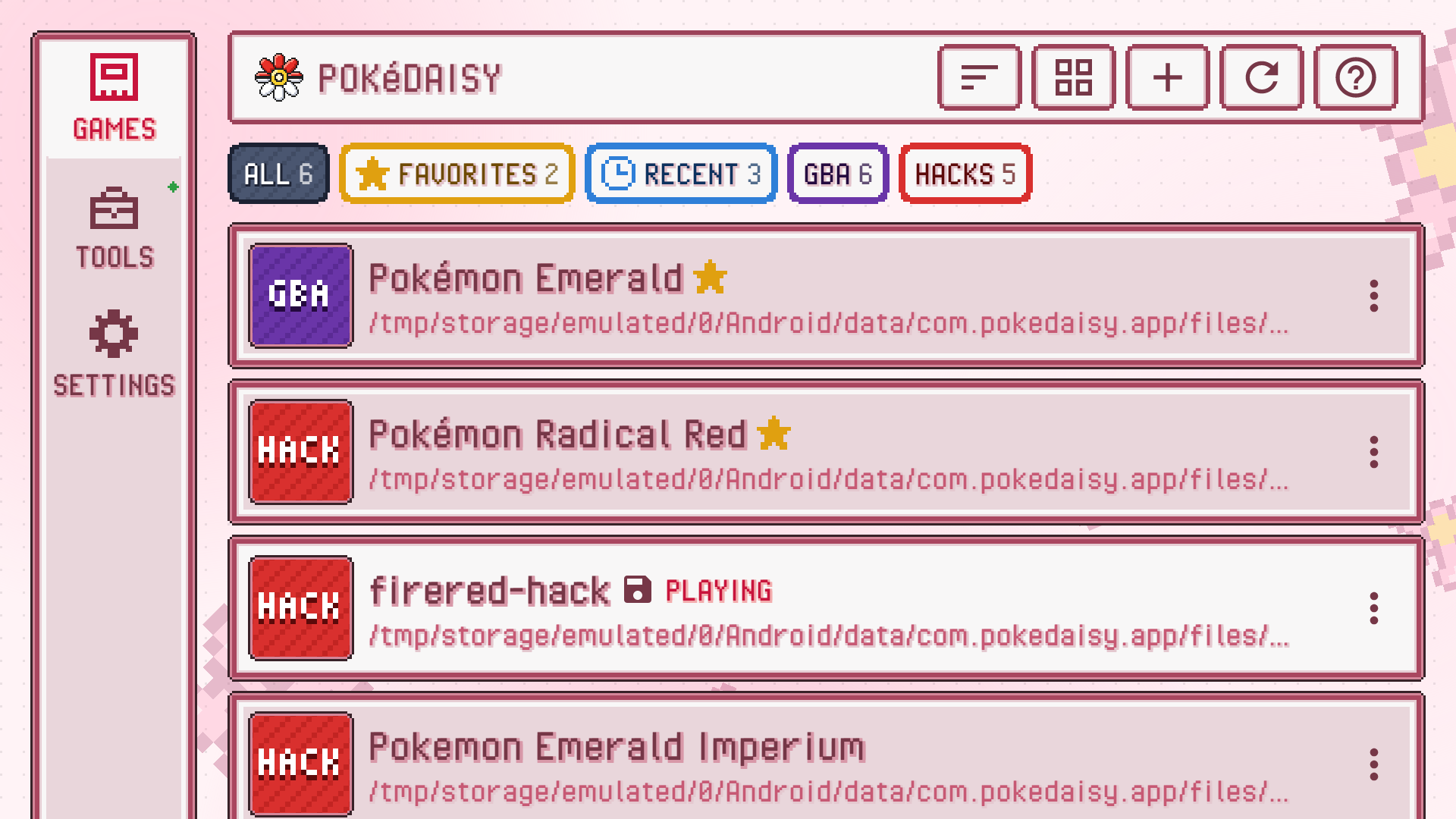
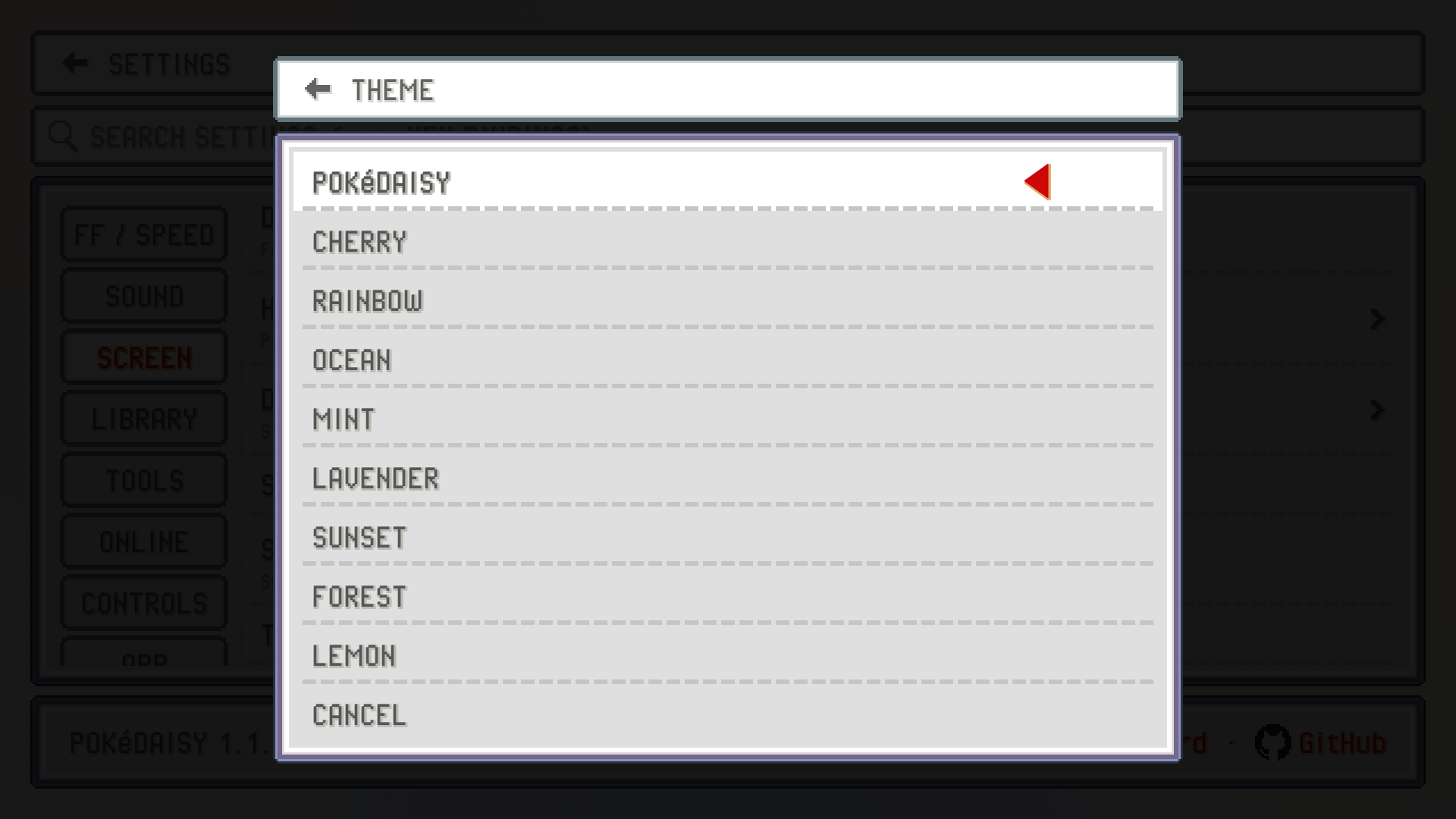
THEME gives the whole app a colour scheme: the library, Settings, setup and the companion while you play, on both screens at once. It works like DARK MODE: the windows take the theme's colour, the values in the lists take its accent, and the backdrop behind them gets its own colours. You can pick it in the top screen's Settings or in the companion's SETTINGS, under SCREEN, and use it with DARK MODE on or off.
POKéDAISY(the default): the classic white and grey windows over the website's light page with soft blobs and floating logos.CHERRY,RAINBOW,OCEAN,MINT,LAVENDER,SUNSET,FORESTandLEMON: always there.CHERRYfloats blossoms over the library, andRAINBOWkeeps the usual windows but fills the tabs and buttons with the colours of the rainbow.
The game's own art stays as it is: party slots, the map, the trainer card and type colours keep the game's look. Behind them, the game's backdrop takes a soft wash of the theme's colour.
Holiday themes
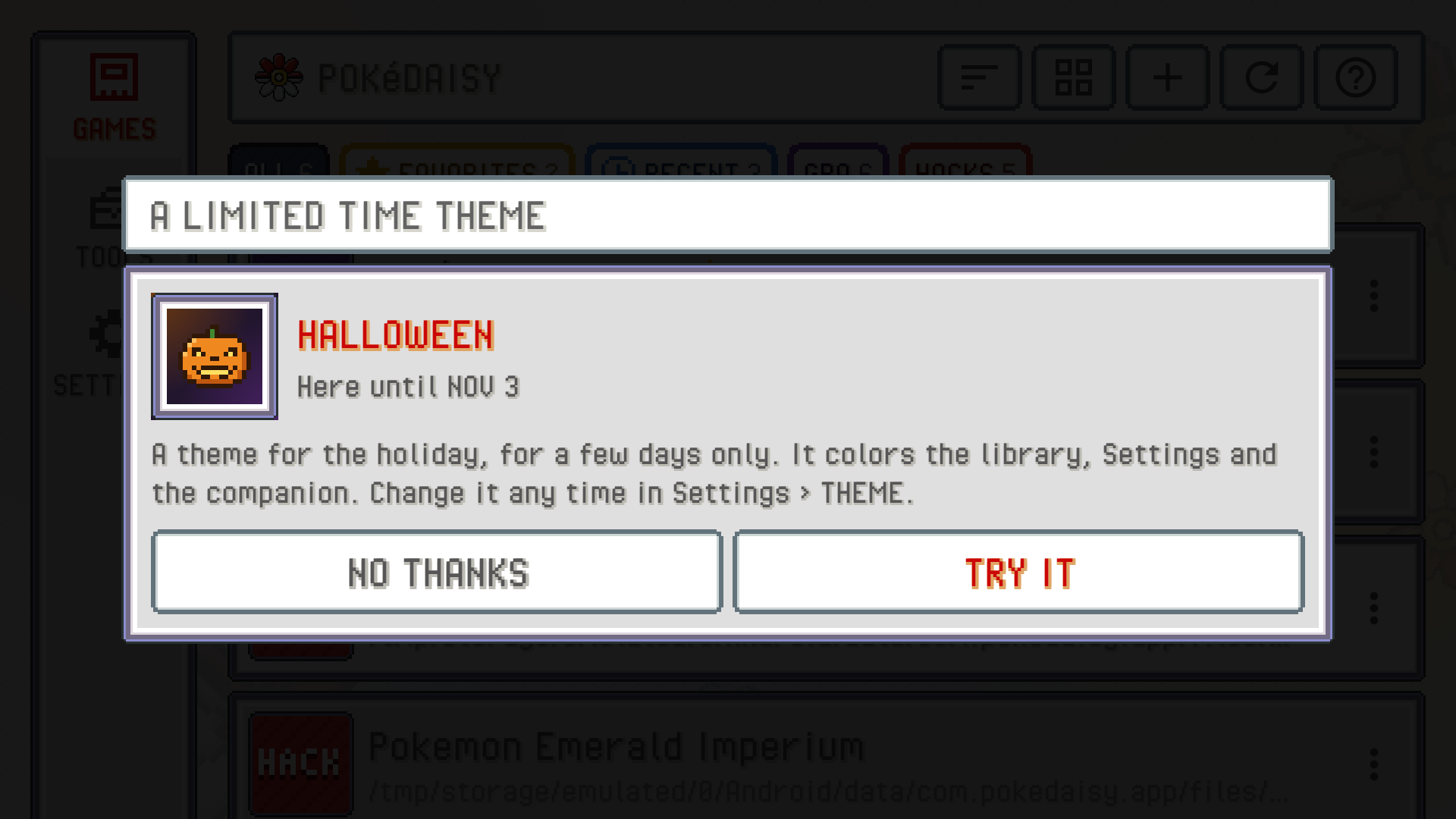
A few themes show up only around a holiday, from a few days before it to a few days after: LUNAR NEW YEAR, VALENTINE'S DAY, ST. PATRICK'S DAY, EASTER, HALLOWEEN, CHRISTMAS and NEW YEAR. Each has its own picture floating over the library (a pumpkin, snowflakes, lanterns and so on) and carries a LIMITED tag in the THEME list.
When one of them arrives, the library tells you once with a small window. TRY IT puts it on right away; NO THANKS leaves your theme alone, and the holiday theme stays in the THEME list until its dates are over. When they end, the app goes back to the theme you had before.
The dates follow your device's calendar. If two holidays overlap (LUNAR NEW YEAR and VALENTINE'S DAY sometimes do), you get one window for each.
FPS / CPU
FPS / CPU shows a small readout in the game's top-left corner: how many frames the game ran in the last second and how much of the CPU PokeDaisy is using. It should read about 60 at normal speed.
Tap the readout to open a longer panel with frame times, late frames, the screen's refresh and pacing, audio underruns, battery temperature, thermal state and memory. It's useful when a game feels choppy; see Troubleshooting.
Game look
COMPANION LOOK, right under THEME, picks how the companion and the HUD look in a game. On GAME (the default), they take on the style of the game you're playing, from the colors of its own menus:
| Game | Companion | HUD |
|---|---|---|
| HeartGold, SoulSilver | Grey blue windows with a dark line, red values, orange buttons | The green menu window, with a red cursor |
| Platinum | White windows in a brown wooden frame, cream lists | Dark slate panels with a silver line |
| Black, White | Navy windows with a cyan rim, charcoal lists and buttons | Navy panels with a cyan rim and a magenta cursor |
| Black 2, White 2 | Violet windows with a white rim, teal values | Violet panels with a pink cursor |
| FireRed, LeafGreen | The bag's cream list in its gold frame | The bag's window |
| Emerald | The bag's cream list in its steel blue frame | The bag's window |
| Ruby, Sapphire | Emerald's frame with their bag's warmer peach list | The bag's window |
| X, Y | Smooth green windows and a rounded font | Their own buttons and panels |
Hacks that run on one of these games wear its look. Other games keep the app's own look. Your theme and DARK MODE still apply around them: in dark mode the light looks give way to the app's dark windows, while Black and White's darker looks stay as they are.
Pick CLASSIC to keep the app's own look in every game, X and Y included. The HUD's own LOOK setting picks GAME for the game's style or one of the app's looks; see HUD.
Light companion for slow devices
On a slower handheld, the companion can keep the device so busy that your button presses reach the game late: you press a button and nothing happens for a moment, often right after FIGHT while the companion draws your moves. LIGHT COMPANION makes the companion easier on the device:
it redraws only when something it shows has changed, and at most twice a second (a battle's menu changing still shows at once);
its animations are off: the bouncing party icons, the blinking map cursor, sliding tabs and the battle buttons' fade;
ON COMPANIONunderSHADERSis off, so no filter is drawn over the companion.
AUTO, the default, turns it on by itself on a device that looks slow, and on any device once your buttons have come late a few times, which it remembers from then on. The line under the setting says what AUTO decided. ON and OFF choose for yourself.
Other screen settings
Something wrong or missing here? Edit this page on GitHub or tell us.