The companion at a glance
What the bottom screen shows, how the tab bar works, and what the companion's SETTINGS tab holds.
The companion is everything on the bottom screen while a game runs. It reads your game as you play, so your party, bag, location and battles are always up to date without opening a single menu on the top screen. It's drawn in the game's own menu style: FireRed's party screen in FireRed, Emerald's in Emerald, and each supported hack's own look where it has one.
You don't have to do anything to start it. Open a supported game and the companion fills in once the game has loaded. On a device with only one screen it lives in a panel beside the game instead (see Devices).
The tabs
Along the bottom of the companion is a row of tabs, with MORE (a grid of nine squares) and the SETTINGS gear at its right end. Out of the box you get:
| Tab | What it shows |
|---|---|
PARTY | Your team, and a full summary for each Pokémon. See Party and summaries. |
DEX | Your Pokédex with seen and caught marks. See Pokédex. |
MAP | The region map with you on it. See Map. |
BAG | Every pocket of your bag. See Bag. |
GUIDE | Hints, the next boss and what's around you. See Guide. |
A few more are off the bar to begin with and wait under MORE: BOXES (your PC boxes, FireRed for now), CARD (your trainer card), STATES (save states) and CHEEVOS (RetroAchievements). So does NUZLOCKE, where you can turn on Nuzlocke tracking for a game.
Some tabs only appear when the game has what they need. DEX needs the game's Pokédex data and GUIDE needs a guide for that game, so a game without them has fewer tabs. The bag tab also takes the game's own word for it: PACK in Gold, Silver, Crystal, Crystal Clear and Prism, CUBE in Unbound, INVENTORY in R.O.W.E., POCKETS in Super Mariomon, BAG everywhere else.
Before you're in the game
While the game is still on its title screen, its intro or the CONTINUE menu, PARTY, BAG, MAP and CARD wait: they show the game's own empty party slots with PRESS START blinking, rather than whatever party the game has loaded so far. They fill in as soon as you're walking around or in a battle. A game resumed from where you left it is in the game already, so they show right away. STATES, SETTINGS and the rest work the whole time, so you can still load a save state from the title screen.
Choosing your tabs
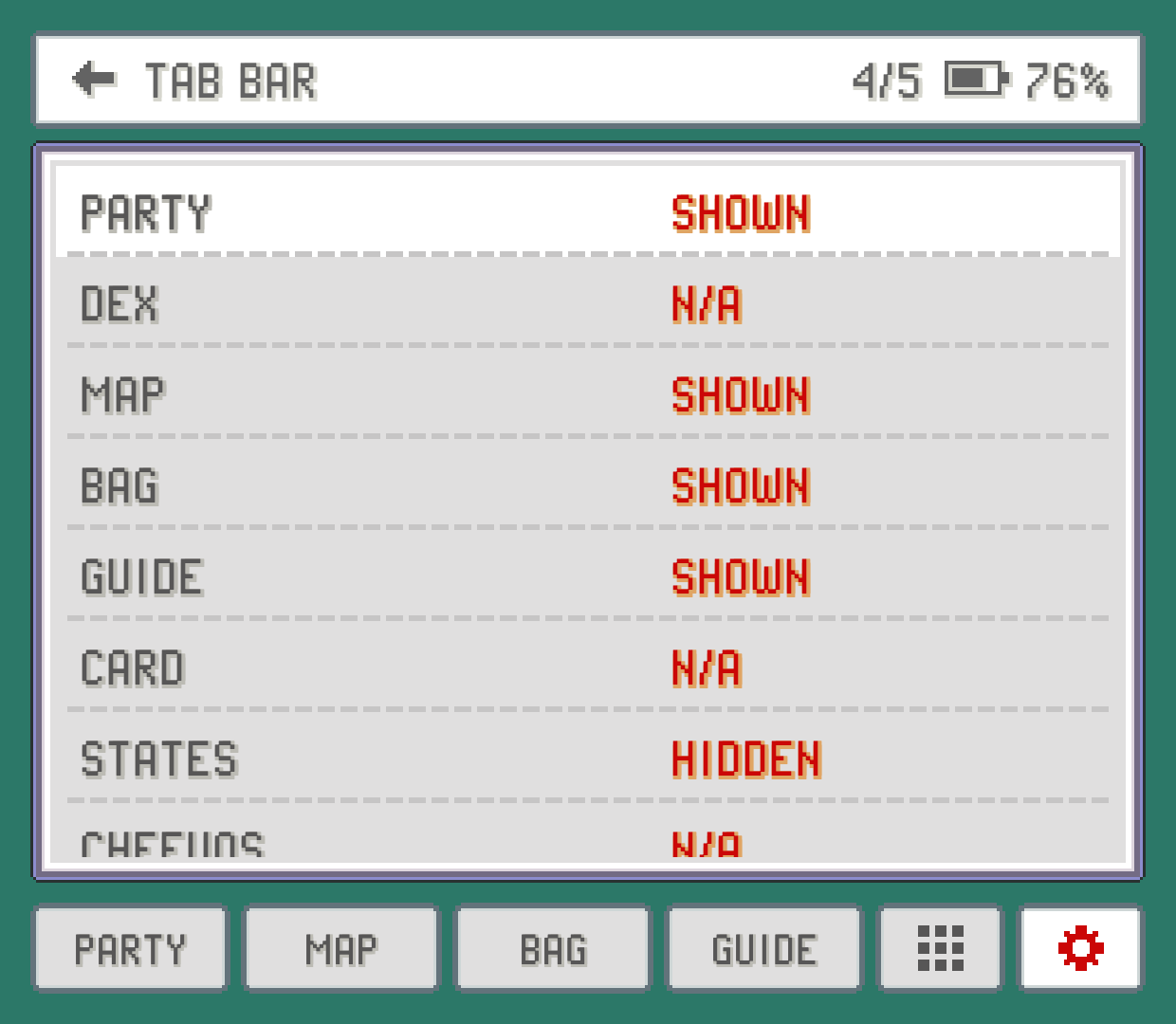
Up to five tabs fit next to the gear. To pick them, open SETTINGS and tap TAB BAR in the COMPANION group, or tap the TAB BAR button at the bottom of MORE. Each tab there says SHOWN or HIDDEN; tap one to flip it. The title counts how many you've placed (for example 5/5). If the bar is full, hide one first. Tabs always sit in the same order on the bar, whichever you pick. When the game you're playing doesn't have one of your tabs (a game with no DEX, say), its place goes to one of the game's other tabs, so the bar stays full whenever the game has enough.
Your choice is shared by every game. A tab the running game doesn't have shows N/A and keeps its setting for the games that do.
Tabs that aren't on the bar
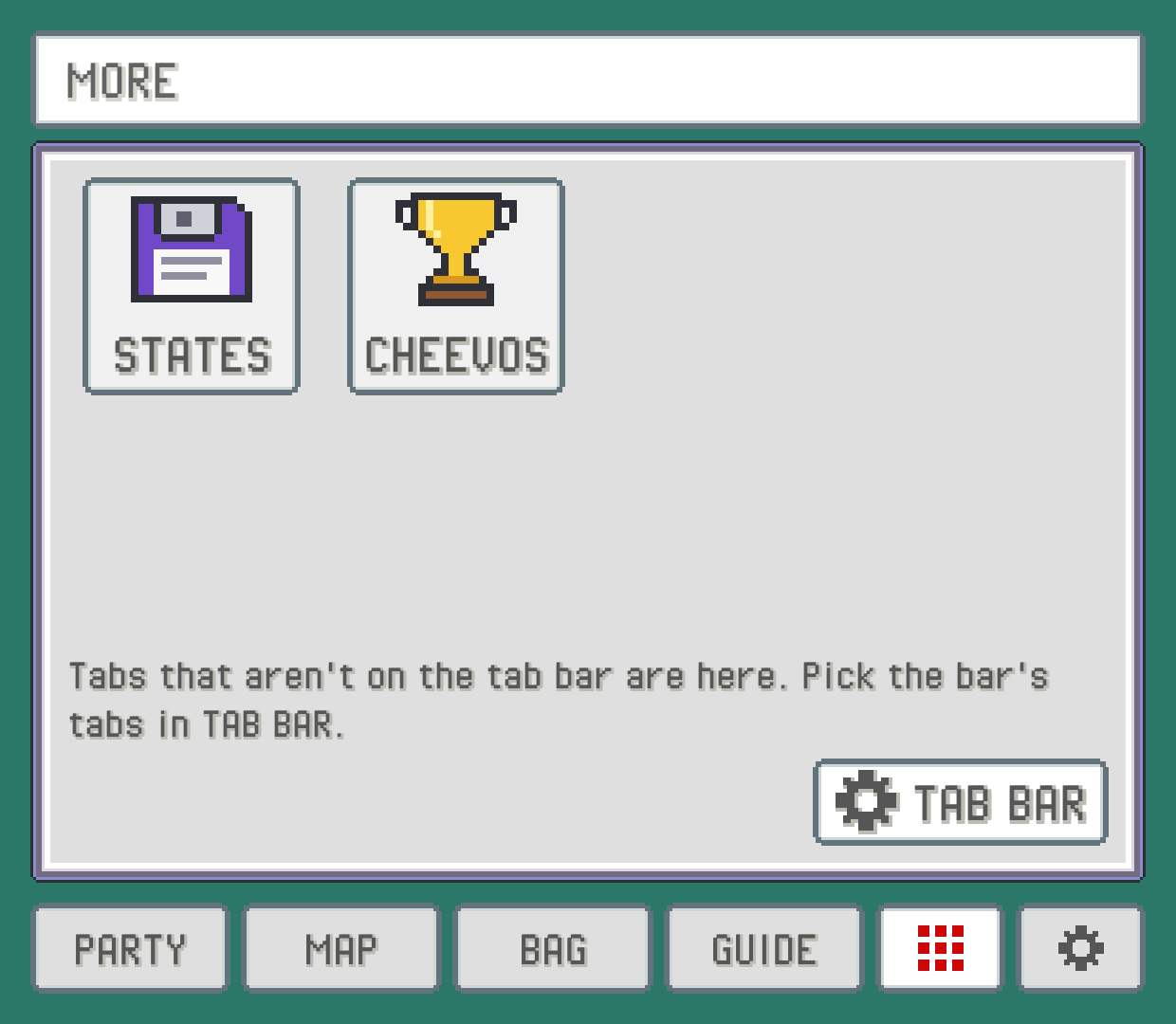
Hidden tabs are still one tap away. Tap MORE, left of the gear: every tab you left off the bar is there as an app, with a coloured icon and its name. Tap one to open it. While it's open MORE stays lit, and BACK takes you back to it.
Under the icons, a line reminds you that you pick the bar's tabs yourself, and the TAB BAR button takes you straight to that page in SETTINGS. When every tab the game has is on the bar, MORE isn't shown.
The BATTLE tab
When a battle starts, a BATTLE tab appears at the front of the bar and opens by itself. To make room, the last of your chosen tabs steps aside until the battle ends. When the battle is over, the tab you had open before comes back. Everything about battles is on the Battles page.
If you'd rather stay where you are when a battle starts, turn off JUMP TO BATTLE in TWEAKS (below): the BATTLE tab still appears, but doesn't open on its own.
The BACK button
The device's BACK button works for the companion, from either screen:
Tap BACK to go back one step in the companion: close a summary, a pick-list, a pop-up window or a sub-page of SETTINGS, or return from a tab you opened from
MORE.Hold BACK to leave the game.
On a controller, the HOME or guide button does the same as a BACK tap unless you've bound it to something else.
Button sounds
Companion buttons play your game's own menu click, recorded from the ROM itself, so they sound like the game. Buttons that press the game's buttons for you (the battle buttons, for example) stay quiet, because the game makes its own sound. There's no vibration. To turn the clicks off, switch CLICK SOUND to OFF in SETTINGS.
The SETTINGS tab
The gear opens the companion's SETTINGS, laid out like FireRed's OPTION screen. The title shows the game's name and your battery. Tap a row to change it: on / off rows flip, rows with more choices open a short list to pick from, and rows with an arrow at their right end open a page of their own. SETTINGS remembers where you were, so a trip to another tab and back lands on the same row.
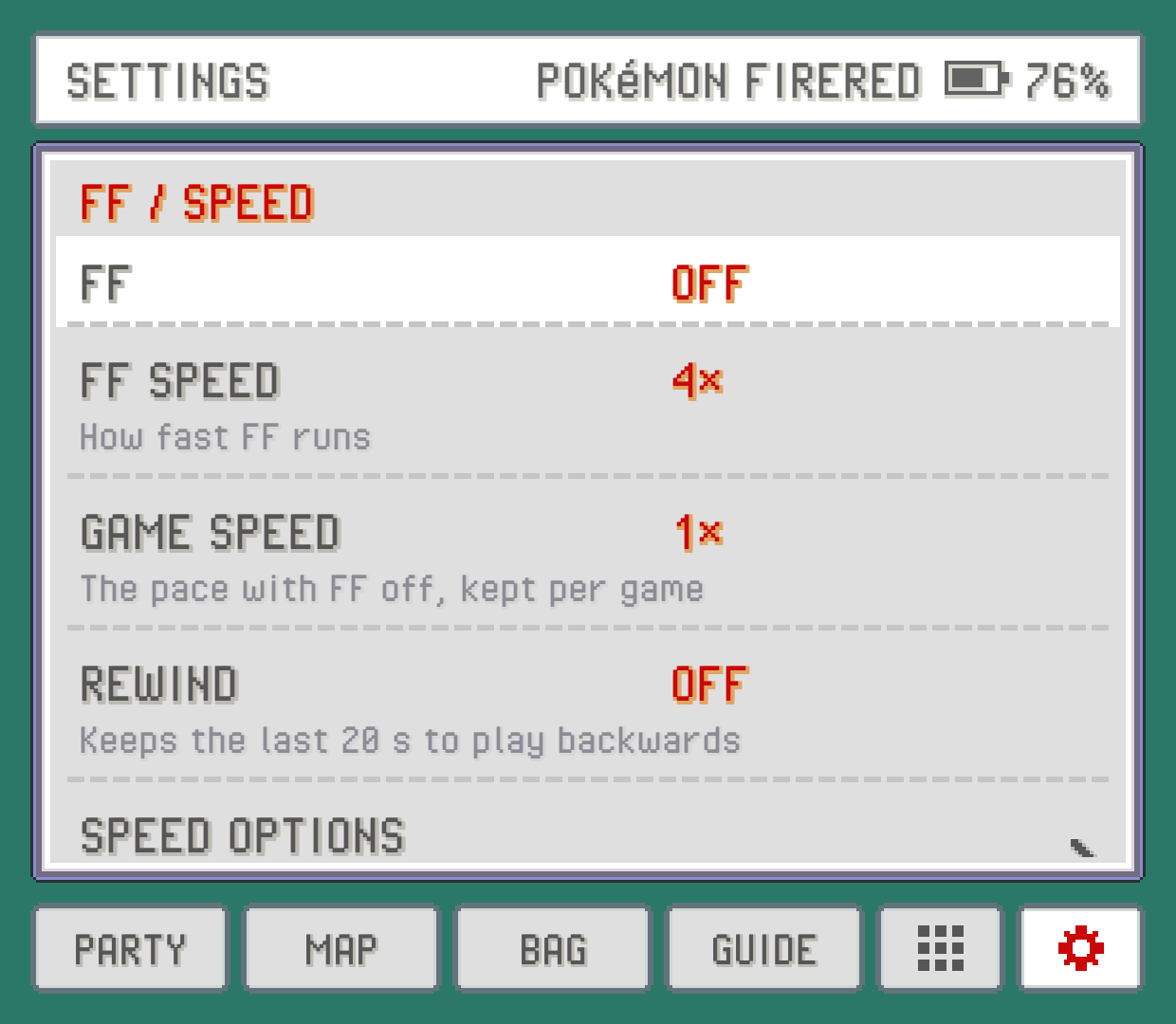
The first two rows change how this list looks, on both screens: DESCRIPTIONS hides the grey line under each setting, and GROUP TABS hides the group buttons beside the list, for a wider one. Both are SHOWN until you hide them.
The options come in groups, the ones you change while playing first:
MAKEOVER:
PLAYER LOOK,RIVAL LOOK,TEXT LOOK,FOLLOWER,FLY ON,RIDE ONandDAY AND NIGHT, fresh looks for your game. It sits at the top in a blue frame of its own, and only shows in a game it works in. See MAKEOVER below.FF / SPEED:
FF,FF SPEED,GAME SPEED,REWINDandSPEED OPTIONS(a page withSCENE SPEEDS,FF MODEandFF MUSIC). See Fast-forward.GAMEPLAY:
WILD ENCOUNTERS,INSTANT TEXT,FLY STYLE,FLIGHT AREA,REUSABLE TMS,AUTO REFILL,NO HMS NEEDED,EXP SHARE,LEVEL CAP,TRADE EVOS,SHINY ODDS,SHINY ALERT,BOSS RETRY,LOW HP BEEP,FIELD POISON,NUZLOCKE,AUTO-RUN,RUN INDOORSandCHEATS. See Controls, Party, Bag, Nuzlocke and Cheats.SCREEN:
ASPECT,HUD,DISPLAY OPTIONS(a page withSTATUS BAR,SHADERS,OVERLAYandLIGHT COMPANION),THEME,DARK MODE,FONT,FPS / CPUand, depending on your device,HIDE BATTLE MENU,BATTLE BUTTONS,COMPANION VIEW,COMPANION BUTTON,SWAP SCREENSorSINGLE SCREEN. See Screen and display.COMPANION:
BATTLE INFO,BATTLE HINTS,BATTLE VIEW,ONE-TAP MOVES,LAST BALL,BATTLE STYLE,FOE IVS,BATTLE FOCUS,TAB BAR,CLICK SOUND,CHALLENGE ICONS,ACHIEVEMENT POPUPS,PROGRESS POPUPSandTWEAKS.CONTROLS:
GAME BUTTONS,HOTKEYS,QUICK MENUandTOUCH CONTROLS. See Controls.APP:
TIPS,LANGUAGEandHELP(this manual).
Every option is explained in the Settings reference. The top screen has its own Settings too, with more options and a search box.
TWEAKS
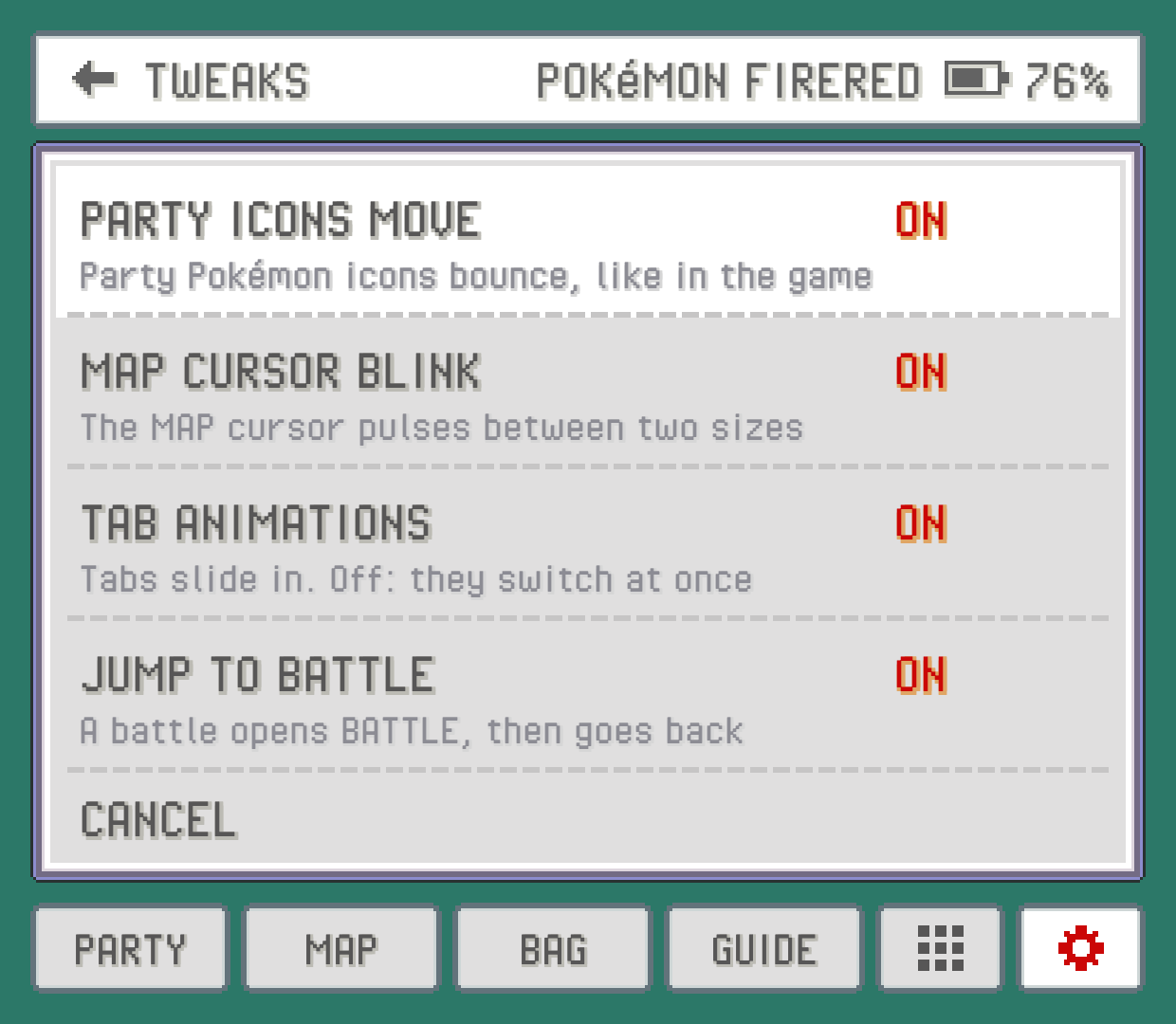
TWEAKS holds small on / off preferences, all on to start with:
| Tweak | What it does |
|---|---|
PARTY ICONS MOVE | Party icons bounce, like in the game. |
MAP CURSOR BLINK | The MAP cursor pulses between two sizes. |
TAB ANIMATIONS | Tabs slide in. Off, they switch at once. |
JUMP TO BATTLE | A battle opens the BATTLE tab, then goes back to where you were. |
MAKEOVER
MAKEOVER is the group at the top of SETTINGS, framed in blue: it brings fresh looks into the game you're playing, with PLAYER LOOK, RIVAL LOOK, TEXT LOOK, FOLLOWER, FLY ON, RIDE ON and DAY AND NIGHT below. It only shows in a game where one of them works.
Sprite packs
PLAYER LOOK, TEXT LOOK and FOLLOWER take their pictures from the other games. Usually that means having those games in your library, but a sprite pack works too: one file that holds the heroes, the text boxes and letters, and the Pokémon that follow you.
If you have a sprite pack, open TOOLS in the library, tap SPRITE PACK and pick the file. A window says what it added, and from then on those looks show in every game's MAKEOVER as if you'd played the games they come from. Loading the same pack again adds nothing, and you can keep using your library's games alongside it.
PokeDaisy only takes the pictures it already knows from those games, checked one by one, so a pack can't change anything else in your game. Anything in it that PokeDaisy doesn't know is left out, and the window says how much.
PLAYER LOOK
Ever wanted to walk around Emerald as the hero of FireRed, or the other way round? PLAYER LOOK dresses you up as another game's hero. Your sprite on the map changes (walking, running, on a bike, surfing, fishing), and so do your back in battle, your picture on the trainer card and your head on the region map. The companion's MAP and CARD follow along.
Tap the row and every hero you can wear shows as a tile, each one walking in place as they look on the map, with the game they come from under their name. The first tile, OFF, is your own hero. Tap a tile to put it on.
PokeDaisy doesn't come with any of these pictures: they're taken from your own copy of the other game. So the tiles only show heroes from FireRed, LeafGreen, Ruby, Sapphire or Emerald carts, or from Heart and Soul, that you've played here once, that are in your library or that came in a sprite pack. Each of those games gives you its two heroes (Ruby and Sapphire's look a little different from Emerald's, and Heart and Soul brings Gold and Kris), and you can also pick the other hero of the game you're playing. Heart and Soul's heroes can be worn in the other games, but Heart and Soul itself keeps its own. Until one is found the row shows N/A. It starts on OFF (your own hero), and each game remembers its own pick.
Your save stays exactly as it was. The change only lives in the game's memory while you play, and the save just notes which of the game's two heroes you are. Turn it OFF and your own hero is back at once, and the save opens the same in any other emulator.
You can also walk around as one of your own Pokémon. With a game whose Pokémon follow you (Heart and Soul, R.O.W.E., Recharged Yellow or Emerald Seaglass) played here or in your library, the tiles also show the Pokémon in your party, walking as they follow you in that game. With more than one of those games, each Pokémon comes from one of them only, and its tile says which. Pick one and it takes your place on the map (walking, running, on a bike and surfing), on the trainer card and with its back to you in battle. Only the first 386 can be picked, and a few of the very biggest aren't among them.
RIVAL LOOK
In Ruby, Sapphire and Emerald your rival is the game's other hero. With RIVAL LOOK on (it starts on), they dress up too, as the other hero of the game you picked: wear FireRed's boy and your rival turns up as its girl, on the map and in battle. Turn it OFF and your rival keeps their own look while you wear another. It shows N/A until you pick a PLAYER LOOK, and FireRed and LeafGreen don't have it (their rival isn't one of the heroes).
TEXT LOOK
TEXT LOOK gives your game the other game's text boxes and letters: FireRed's rounded blue and white box in Emerald, or Emerald's teal one in FireRed and LeafGreen. Everything people say, signs and the save question show in it, and the letters of every menu change too.
Like the heroes, the box and the letters come from your own copy of the other game, so the row shows once you've played it here, it's in your library or it came in a sprite pack. Tap it to switch between your game's own look (OFF) and the other game's. Your save isn't touched.
FOLLOWER
With FOLLOWER on, the first Pokémon in your party walks a step behind you on the map, turning corners with you, keeping up when you run or ride your bike, and waiting while you surf. It's drawn by PokeDaisy over the game, so your game and your save don't change. It doesn't block anyone and you can't talk to it, and after you go through a door it shows up again with your first step.
Its sprite comes from a game whose Pokémon follow you (Heart and Soul, R.O.W.E., Recharged Yellow or Emerald Seaglass), like the Pokémon you can wear with PLAYER LOOK, so the row shows N/A until one of those has been played here or is in your library, or a sprite pack brought its Pokémon. It's off to start with, and games whose Pokémon already follow you don't have it.
RIDE ON
RIDE ON swaps your bike for a MOTORCYCLE or a SCOOTER. Get on your bike as usual and you ride the one you picked instead, seen from the side, from the front and from behind like the game's own bike, and you stop pedalling. A little smoke puffs out of the exhaust behind you, more of it while you ride. BIKE is the game's own.
It works in FireRed, LeafGreen, Ruby, Sapphire and Emerald (both of Emerald's bikes), and in the hacks where PLAYER LOOK works. It keeps its own colours whoever rides it, and it goes along with PLAYER LOOK: another game's hero rides it too. Your game and your save don't change, and your pick is the same in every game.
FLY ON
FLY ON picks what carries you when you fly over the map with TAKE OFF, or fly to a town the scenic way: your Pokémon's bird (BIRD, the game's own), an AIR BALLOON, a HELICOPTER, a ZEPPELIN or a small PLANE. You ride in it, your head and shoulders showing over the basket, through the cockpit glass or the gondola's window, and it comes in empty to pick you up and flies off empty after you land. You face the way you fly, left or right; in the balloon you also turn your back going up and face the front going down. The burner flickers, the rotors spin and the propellers turn; the helicopter, the zeppelin and the plane lean a little as they turn, and the balloon floats upright.
The vehicles are drawn by PokeDaisy over the game, so your game and your save don't change. The row shows in the games that have TAKE OFF, it starts on BIRD, and your pick is the same in every game. Changing it in the air swaps your ride at once. The game's own flying animation (FLY STYLE set to CLASSIC) keeps its bird.
DAY AND NIGHT
With DAY AND NIGHT on, the map follows your device's clock: a soft pink at dawn, the game's own colours by day, an orange glow at dusk and a deep blue at night. Only the outdoors changes, and only while you walk around: text boxes and menus keep their colours, buildings stay lit, and battles look as they always do. It eases in and out as you go between them.
It works in every GBA game except those that already change with the time of day themselves (Unbound, Heart and Soul, Elite Redux). It's off to start with. Your game and your save don't change: only the picture does.
TIPS
PokeDaisy does a lot, and some of it is easy to miss. Once you've played for about half an hour, a small card with the PokeDaisy flower now and then shows you a feature you haven't tried yet, like the zoom and look around with EXPAND, the QUICK MENU, AUTO-RUN or the PC from anywhere. With two screens it shows on the companion, so the game stays clear; on one screen it sits at the top of the game.
Most cards come up when the feature would help right then: AUTO-RUN after you've held B to run for a while, WILD ENCOUNTERS after a few wild battles in a row, REUSABLE TMS right after a TM gets used up.
One card doesn't wait the half hour: the first time you play a DS game on a one-screen device, a card a few seconds in shows what your triggers do there (L2 brings in the touch screen, R2 moves to the next DS LAYOUT). It goes for good once you answer it or press either trigger yourself.
TRY IT (its button says what it does, like
TURN ONorSHOW ME) does the thing at once.NO THANKSmeans that card never comes back.Leave it, and it goes by itself when its bar runs out. It may come back once, much later.
A card only shows while you're walking around the field, never in a battle, a menu or a conversation. There are always at least 5 minutes of play between two cards, and a feature you already use never gets one. Turn them off with TIPS in the APP group, on either screen.
LANGUAGE
The app's own text comes in English, Japanese, Korean, French, German, Italian, Spanish and Portuguese, with Brazil's and Portugal's Portuguese as two choices. LANGUAGE starts on AUTO, which follows the game's language; pick another and both screens switch at once.
No game came out in Portuguese, so on a phone or handheld set to Portuguese, AUTO shows Portuguese over an English game too. A Korean DS game picks Korean by itself; on a device set to Korean, the library and settings are in Korean too. The GUIDE's written pages stay in English in Portuguese and Korean.
This only changes PokeDaisy's words (buttons, labels, hints). Pokémon, move and item names stay as your game has them, so a French game shows its French names whatever you pick, and an English game keeps its English ones.
Closing and restarting
At the very end of SETTINGS, under a line, are two buttons:
CLOSE GAMEreturns to your library. WithRESUME GAMESon (top-screen Settings, the default), the game picks up where you left it next time. With it off, anything since your last in-game save is lost, and the confirmation says so.RESTART GAMEreboots the game and reads its save file again from storage. Anything you haven't saved in the game is lost. It's the fix when a save you copied in doesn't show up.
Both ask before they do anything.
On a device with two screens there's also CLOSE COMPANION. It hands the companion's screen back to Android while the game keeps running, so you can use another app there (the top screen with SWAP SCREENS on). Press BACK on the game to bring the companion back. With SWAP SCREENS on, BACK opens it over the game instead, and OPEN COMPANION at the bottom of its SETTINGS puts it back on the top screen.
Something wrong or missing here? Edit this page on GitHub or tell us.